
As part of its ongoing efforts to alleviate the suffering of the most vulnerable groups and enhance their economic independence, the International Islamic Charity Organization (IICO)launched a project to empower widowed mothers and mothers of orphans through its office in Sudan.
The project included training beneficiaries in food processing skills within an integrated program carefully designed to cover the practical and administrative aspects of small business management. This enabled them to acquire technical expertise and the ability to manage their productive projects independently and successfully.
The project paves the way for beneficiaries to launch sustainable productive enterprises that contribute to improving household income and strengthening self-reliance, in addition to promoting a culture of community entrepreneurship within local communities.
After completing the training and based on a study of the local market, the project proceeded to provide beneficiaries with ownership of the means of production for each project, in line with each beneficiary’s capabilities and actual market requirements.
The projects included two main types: the first related to the production and sale of spices, and the second focused on the manufacture of pastries and baked goods and the sale of fried potatoes, enabling each beneficiary to manage her project independently and effectively.
Thus, each beneficiary came to own an independent production unit equipped with the necessary tools and equipment, enabling them to practically apply the technical and marketing skills acquired during training, and placing them on the first steps of the journey toward economic independence and achieving sustainable income that ensures a better standard of living for them and their families.
The project also contributed to supporting the concepts of innovation and economic responsibility, and empowering beneficiaries to actively contribute to local development and utilize resources in ways that serve market needs.
The project aims to qualify beneficiaries by training them in food processing and small business management, while providing them with essential production equipment to ensure the effective operation of each project.
It also seeks to empower beneficiaries to manage independent projects in line with local market requirements, ensuring income sustainability and the achievement of genuine economic independence. 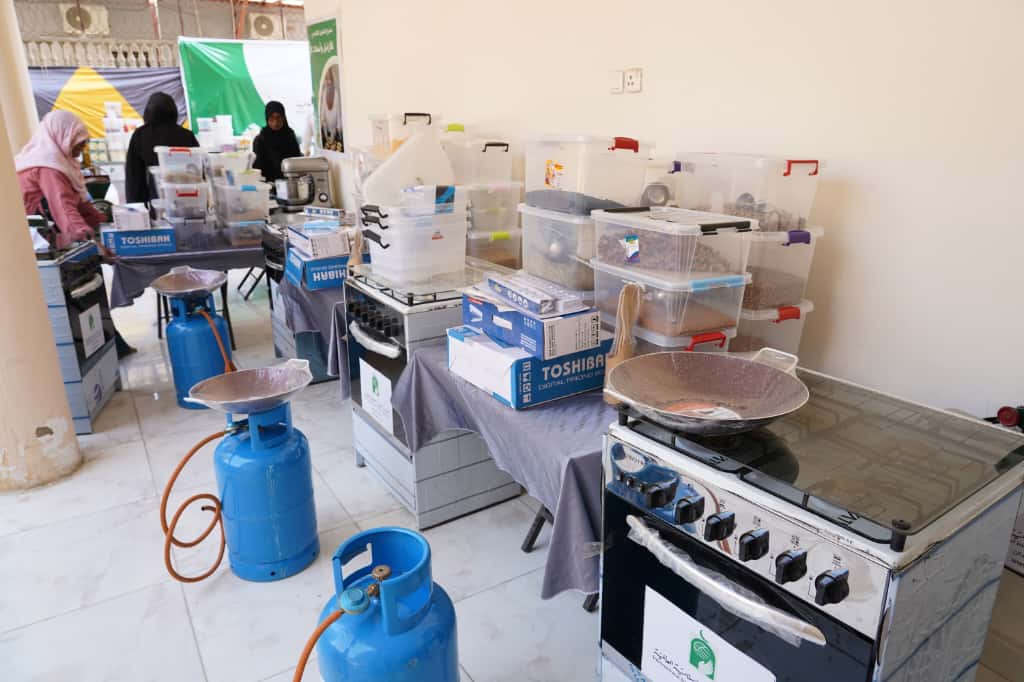
The project further seeks to enhance the spirit of entrepreneurship among widowed mothers and mothers of orphans, contributing to improving their economic conditions and empowering them to rely on themselves.
The project places particular emphasis on providing continuous technical and logistical support to ensure quality operations and project sustainability. Each project is accompanied by a set of manuals and an electronic operating guide that enables beneficiaries to manage their businesses successfully, while enhancing their ability to face challenges and keep pace with market requirements.
The project has already succeeded in achieving all its core objectives, with continued technical and logistical support during the first months to ensure sustainable operation and maximize the benefits of the projects. This enhances the beneficiaries’ ability to manage their businesses efficiently, achieve sustainable income, and realize tangible improvements in the living conditions of their families.
According to a defined timeline, the project was implemented through successive phases, beginning with the nomination of beneficiaries in cooperation with three specialized organizations and the Ministry of Social Welfare in Port Sudan State, to ensure the selection of the most deserving group. This was followed by an introductory meeting between beneficiaries and project managers to clarify the project’s objectives, implementation mechanisms, and to strengthen the spirit of cooperation and responsibility before the start of practical and training activities.
The project included a theoretical training program at an accredited training center, focusing on the basics of food processing, principles of entrepreneurship, and small business management, to equip beneficiaries with the knowledge and skills required.
It also included field visits to the local market to familiarize beneficiaries with actual market requirements, including prices, supply and demand volumes, and consumer needs. This enabled them to choose the most suitable project that achieves economic feasibility and sustainability in the local market.
After the training, beneficiaries were provided with ownership of essential production equipment and necessary input materials for each project, along with packaging and labeling techniques in accordance with health standards and quality requirements, ensuring that projects were fully ready for operation.
Technical and logistical support continued after the handover through regular field follow-ups, a direct communication channel, and the provision of a simplified electronic operating guide that facilitates project management and enhances opportunities for long-term sustainability.
The project contributed to achieving a range of practical and developmental outputs, including the successful training of beneficiaries in food processing and small business management, providing them with ownership of diverse small productive projects, and operating these projects in accordance with safety and quality standards in coordination with the Standards and Metrology Authority. This contributed to achieving the first steps toward economic independence for beneficiaries, with the possibility of monitoring sales rates and revenues in the coming months.
The project is distinguished by combining training and asset ownership to ensure project sustainability, targeting the most needy widowed mothers and mothers of orphans, and providing continuous technical and logistical support after ownership to enhance operational quality and sustainability. It also instills the spirit of entrepreneurship and self-reliance, contributing to improving the economic conditions of targeted families.
This project represents a living model of the impact of charitable work in improving the lives of the most vulnerable groups and promoting community entrepreneurship, and embodies the ability of development initiatives to transform material and training support into sustainable economic and social impact.
