
The Humanitarian Coalition for Sudan called on the international community and donors to quickly provide urgent humanitarian aid to the Sudanese people, and to establish mobile health services and field hospitals in the affected Sudanese cities and regions.
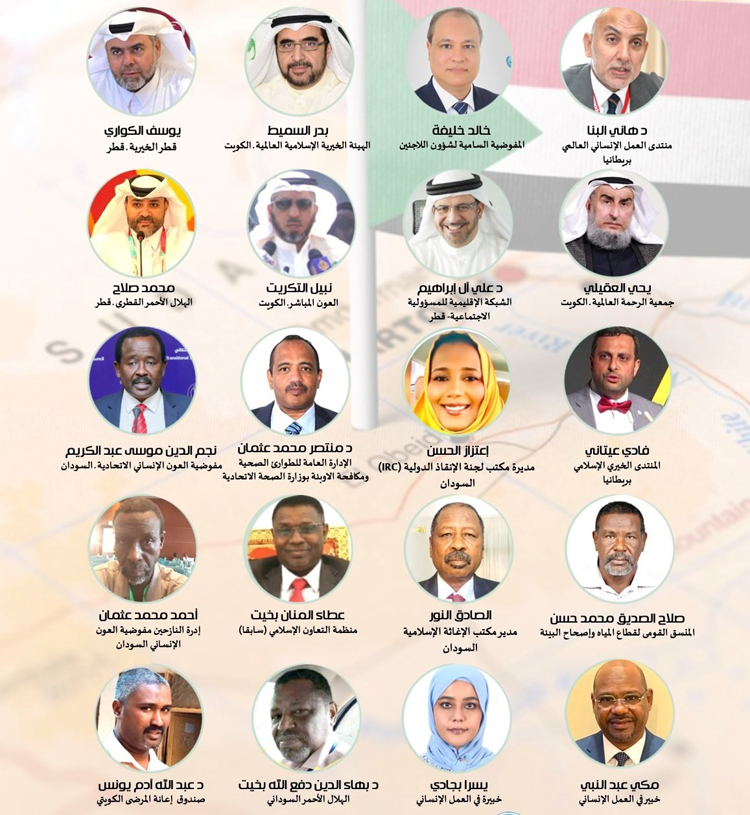
This humanitarian appeal was launched by the international humanitarian forum organized by The World Humanitarian Action Forum, on the dimensions of the humanitarian situation in Sudan, with the participation of a group of representatives of the United Nations specialized agencies, Gulf and international humanitarian organizations, and a number of actors and experts in the humanitarian field, who felt their humanitarian responsibility and duty regarding the conflict in Sudan and its humanitarian repercussions.
On May 8 of this year, the Coalition organized a humanitarian meeting via the "Zoom" application on the dimensions of the humanitarian situation in Sudan, and the importance of the humanitarian response to support the Sudanese people in their ordeal, in which it warned of catastrophic consequences of the armed conflict and the exacerbation of the humanitarian situation.
The Coalition appealed to the parties to the conflict to prevail the interests of Sudan over personal interests, to spare it the scourge of destruction and fragmentation, and to neutralize housing, health and educational facilities and infrastructure from the conflict.
It urged the neighboring countries of Sudan and the Gulf states to send urgent health and medical aid, and called on the active humanitarian organizations in Sudan to coordinate with the Coalition in providing aid, in addition to appealing to the responsible authorities to work to ensure their security, freedom of movement and the implementation of their programs.
From his part, IICO Director General, Eng. Badr Al-Sumait, in his intervention, said that the IICO is distinguished by the presence of one of its ten most important regional offices around the world in Sudan, which is an advantage that enables it to play a tangible role in this aspect, in light of the office’s cooperation with 11 partners from national organizations registered and accredited by the Sudan Humanitarian Aid Commission and an extended network of nationwide volunteer teams and individuals.
He continued: Our office provided an assessment of the humanitarian situation and its developments, in which it warned of its seriousness, the increasing humanitarian needs of the internally displaced in particular, and identified the needs and priority areas for humanitarian intervention.
According to our office in Sudan, the possible interventions can be classified according to the level of risk to direct humanitarian intervention in conflict areas; the most prominent of which are the states: Khartoum, Khartoum North, and Darfur, recognizing that this type of intervention entails a high risk, requiring careful coordination with the concerned official authorities, finding safe passages, and declaring a truce that must be adhered to.
Al-Sumait referred to the indirect humanitarian intervention in the safe areas, where internal displacement is in each of the states: River Nile, Gezira, and Red Sea, and they are in urgent need to provide shelter, daily living needs, medical supplies, and other necessary needs for the displaced.
He referred to a third type of indirect humanitarian intervention through the neighboring countries of the Republic of Sudan, where resorting to the border countries; Such as: Chad, Egypt, South Sudan, Ethiopia, and other countries likely to receive refugees if the conflict extends, as refugees in those countries are expected to suffer from challenges related to their living capabilities in unfamiliar environments.
Al-Sumait referred that previous experiences of humanitarian interventions in conflict areas reflected the justified concerns of many humanitarian organizations; especially in terms of the safety and security of its operating field crews, and its ability to deliver humanitarian support to the deserving groups in an efficient and effective manner.
In order to mitigate the effects of those risks expected in this type of intervention, Al-Sumait called for urgent and serious intervention by governments and international organizations on both sides of the conflict in the Republic of Sudan in order to stop the violence affecting civilians, and to enforce respect for the principles of humanitarian action; foremost among them ensuring that aid reaches those in need.
He stressed the importance of full coordination with the official authorities inside Sudan, including The Federal Humanitarian Aid Commission and its branches in each state, as well as with the authorities of those states directly, in addition to coordination with the United Nations Program for the Coordination of Humanitarian Affairs and United Nations agencies, with the help of humanitarian work laws, and the exercise of all necessary efforts to obtain appropriate guarantees that allow humanitarian organizations to carry out their roles without any threat.
He emphasized the necessity of transporting materials and needs provided by humanitarian organizations under the direct supervision of the official authorities, and through approved transport companies with appropriate experience in securing transportation in similar circumstances to ensure that it reaches its beneficiaries, and that it does not fall into the wrong hands.
Al-Sumait hinted that the raging armed conflict within the states and populated areas has caused increasing numbers of victims day after day, and an almost total collapse of the basic infrastructure, especially the health infrastructure necessary to preserve and save souls, which is crucial in reducing the high number of deaths, with a sharp decline in the ability to provide basic services, and the numbers of forcibly displaced persons that are expected to increase; whether from the internally displaced to safer areas, or from refugees to other countries.
He added: Any quick and inevitable action by humanitarian organizations shall be supported by immediate action by governments and international organizations to stop the bloodshed, extend a helping hand to the vulnerable and needy, and prevent a long-term and imminent humanitarian catastrophe in the event that the current pace of conflict continues.
The Director General appreciated the principles of the Humanitarian Coalition to support the humanitarian situation in Sudan. He affirmed the readiness of IICO to cooperate with the partners who call for it, in order to save and protect lives, and mitigate the effects of the conflict on civilians to the maximum extent possible.
He sincerely thanked the Humanitarian Forum teamwork, headed by Dr. Hani Al-Banna, for their efforts in the framework of coordinating humanitarian action, and for his generous initiative of calling for this humanitarian coalition for Sudan, and he also thanked all participants who responded to the initiative.
